
The good news is that matching is very achievable, and it isn't complicated in principle. It comes down to two things done in the right order: get the fitment right first, then match the appearance. Reverse that order and you end up with a wheel that looks close but doesn't drive right, which is the worse outcome.
This guide covers what "factory look" actually consists of, and one important distinction that gets blurred in a lot of wheel marketing — including ours, potentially.
What You're Trying to Avoid
You're replacing one wheel, and you want the car to look like nothing happened. Situations where this matters most:
- A single wheel damaged by a pothole, curb, or impact — see what to check after a pothole
- A cracked wheel that has to be replaced
- A wheel damaged beyond repair, with three good ones remaining
- A leased vehicle or one you plan to sell, where mismatched wheels cost you money
- A wheel you simply see every day and don't want to look wrong
What "Factory Look" Really Requires
"Factory look" is made of four things
- Diameter — the wheel's size. Almost always the first thing the eye notices if wrong.
- Width and stance — affects how the wheel sits relative to the fender.
- Design — spoke count, spoke shape, and overall pattern.
- Finish — silver, gray, black, machined, polished, or painted; and how glossy.
Match all four and the casual observer won't be able to tell which wheel was replaced.
OEM-style is not OEM
This distinction matters and it's worth being precise about:
- OEM means the wheel was made by or for your vehicle's manufacturer, supplied through the manufacturer's parts channel.
- OEM-style means a wheel designed to match the original's specifications and appearance — diameter, width, bolt pattern, offset, hub bore, and visual style.
An OEM-style replacement wheel is not a manufacturer-original part, and it should not be described as one. What it's designed to do is match the original's fitment and appearance, which for most single-wheel replacements is exactly what's needed. Dealer wheel vs. replacement wheel compares the two paths in full.
What to Match Before You Order
Get the numbers off the car before you shop:
- Look at the driver's door jamb sticker — it lists the vehicle's original tire and wheel size.
- Check the wheel itself. Specifications are often stamped or cast on the back side of the spokes or inside the barrel. You may need to remove the wheel, or ask a shop to read it.
- Note the finish honestly. "Silver" covers a wide range. Compare in daylight, and photograph the good wheel next to a reference.
- Confirm how many wheels you're matching — three others, or a different count.
- Confirm whether TPMS sensors need to transfer, and whether the tire is being reused.
Then confirm the five fitment specifications: diameter, width, bolt pattern, offset, hub bore. Appearance matching only matters after these are right — a wheel that matches visually but has the wrong offset will rub, sit proud, or change how the car drives. How to check wheel fitment walks through each one.
How to Get a Match, Step by Step
The order that works
Step 1 — Is the damaged wheel repairable? If a qualified repair facility confirms a minor bend with no crack, repair may preserve the original wheel, which is the cleanest possible appearance outcome — it's the same wheel. If there's a crack, or it won't seal, replacement is the path; Bent Wheel: Repair or Replace? covers that call.
Step 2 — Replacement or full-set change? If the other wheels are fine, replace one and match it. A full-set change is a different decision, driven by wanting a different look or needing multiple replacements — not by one damaged wheel.
Step 3 — Match specification first, appearance second. Specification is pass/fail. Appearance is a spectrum. Do them in that order.
Step 4 — Decide what "match" needs to mean for you. - Strict visual match: same design and finish as the other three - Close match: correct specification, similar style - Deliberate change: different design — which is a valid choice, just a different goal
Step 5 — Have the tire and sensor handled correctly. Mounting, balancing, and TPMS transfer affect whether the job is actually finished when the wheel arrives.
Fitment Is Half of Matching the Look
For appearance matching specifically, note that two of the five specifications are also visual:
- Diameter — affects both fit and look
- Width — affects both fit and stance
- Bolt pattern — invisible, but pass/fail
- Offset — affects fit and how the wheel sits in the arch; visually noticeable when wrong
- Hub bore — invisible, but wrong centering causes vibration
The common mistake: buying a wheel with the right diameter and bolt pattern and ignoring offset. It bolts on, it looks roughly right standing still, and then it rubs or sits proud of the fender.
Before You Order
- Specification match — all five, verified to your vehicle
- Design match — spoke pattern and shape
- Finish match — confirmed in daylight, not a product photo
- Condition — new, OEM-style, reconditioned, or used, stated plainly
- How many you're buying — one to match three, or otherwise
- Return terms — if the finish doesn't match in person
- Support — can fitment be confirmed before shipping
Why Matching the Original Matters to Us
Matching what's already on the car is the whole point here, so it's worth saying plainly:
Replace what you need. Keep the factory look.
That's the whole proposition in two sentences — one damaged wheel doesn't become a four-wheel project, and the replacement is chosen to match the three that are already there. Get back on the road with a car that looks like nothing happened.
FAQ
Is an OEM-style wheel the same as an OEM wheel? No. OEM-style means designed to match the original wheel's specifications and appearance. It is not a part manufactured by or for your vehicle's manufacturer, and shouldn't be represented as one.
Will one replacement wheel look different from the other three? It shouldn't, if diameter, width, design, and finish are all matched. That's the entire point of matching — and it's why specification comes before appearance.
Can I replace just one wheel if the other three are fine? Usually yes, when the other wheels are undamaged and the replacement matches. That's the normal case rather than the exception — see Can I replace just one damaged wheel?.
What if I can't find an exact design match? A close match with the correct specification and a similar finish is usually acceptable visually. Getting the specification right matters more than getting the design identical.
Does the finish on a replacement fade differently over time? It can, particularly between a new wheel and three that have aged. Compare in daylight and accept that a brand-new wheel may look very slightly fresher initially.
Is a reconditioned original wheel a better match than an OEM-style wheel? Sometimes — a reconditioned original is literally the same wheel design. Condition and availability decide whether it's the better option in your case.
One Wheel or More Than One?
Impact, leak and vibration problems usually start at one corner, so one wheel is often all that is needed. What decides it is whether the other wheels are damaged as well, and whether a single replacement can be matched to the three that stay on the car.
- One wheel — the damage is on one corner and the other three hold air, run true and are not bent.
- More than one — more than one wheel is damaged, or the remaining wheels cannot be matched for diameter, width, bolt pattern, offset and center bore.
How Many Wheels Should I Replace? 1, 2, or All Four covers the count decision in full. Can I Replace Just One Damaged Wheel? covers matching a single wheel to an otherwise healthy set.
Find the Right Replacement Wheel for Your Vehicle
Four steps take you from "something is wrong with my wheel" to a wheel that is listed for your actual vehicle.
- Check your vehicle. Use the year, make and model selector at the top of this page, or send the details through Fitment Check and we will review them before you order.
- Confirm the five specs. Diameter, width, bolt pattern, offset and center bore. How to Check Wheel Fitment shows where each one is measured.
- Read the size off the tire you have now. How to Find Your Wheel Size shows where the size is printed and how to read it.
- Open your make and choose the wheel listed for your model year.
- Toyota Wheels
- Honda Wheels
- Nissan Wheels
- Tesla Wheels
- Hyundai Wheels
- Kia Wheels
- Ford Wheels
- Chevrolet Wheels
- BMW Wheels
- Volkswagen Wheels
- Mercedes-Benz Wheels
- Lexus Wheels
Browse every replacement wheel if you would rather start from the full catalogue.
Replacement Wheels Listed for Your Vehicle
Each wheel below is listed by the year, make and model it was built for. Open one to see the exact vehicles it covers, then check it against your own specs before ordering.
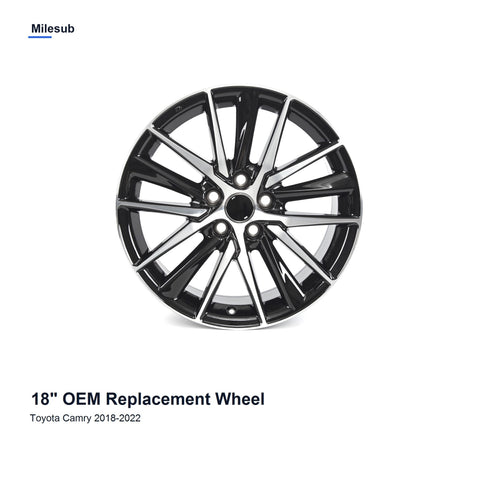 New 18"×8.0" OEM-Style Replacement Wheel for Toyota Camry 2018-2022 Machined Black
$179.99
View Wheel →
 New 19"×8.5" OEM-Style Replacement Wheel for Honda Accord 2016-2017 Machined Black
$188.99
View Wheel →
 New 17"×7.5" OEM-Style Replacement Wheel for Toyota Corolla 2019-2022 Gloss Black Machined Silver
$189.99
View Wheel →
Ready to Find the Right Wheel?
Tell us your year, make, and model, and we will show you wheels built for your vehicle.