
This guide doesn't start with an answer, because the answer depends on what an inspection finds. It starts with the sequence that professionals actually use: inspect, then diagnose, then decide between repair and replacement. Where you land depends on where the damage is, how severe it is, what the wheel is made of, and what you need the car to do afterward.
Where You Probably Are Right Now
You already know something is wrong. Usually one of these brought you here:
- A shop told you the wheel is bent and quoted both options
- The wheel keeps losing air and a leak-down test pointed at the bead area
- There's a vibration that doesn't go away with balancing — start with why a wheel or steering wheel vibrates
- You can see the rim isn't round when the wheel spins
The question now is whether that wheel is worth saving. If a specific impact started this, what to check after a pothole hit is the first step.
What "Repairable" Actually Means
"Where is the damage, and how bad" is what determines the answer. Three things matter:
1. Location | Location | Typical implication — assessed by a professional after inspection, not by eye | |---|---| | Outer lip only | Most often repairable if inspection confirms there is no crack | | Inner lip | Harder to see, affects sealing — needs professional assessment | | Barrel (the cylindrical center) | More serious; affects structural integrity | | Mounting face / hub area | Most serious — this is where the wheel attaches to the car | | Spokes | Structural; generally replacement territory |
2. Material - Steel wheels usually deform rather than crack, and can often be straightened by a qualified wheel repair facility — but they also tend to be the least expensive to replace outright. - Alloy wheels can crack instead of bending, and repeated heating or force during straightening can weaken them. Repairability is genuinely case-by-case.
3. Severity - Cosmetic scuffing with no air loss, no vibration → often no action needed beyond a professional look-over, and worth having checked if the impact was significant - Mild bend, holds air, balances out → repair may be reasonable - Crack of any kind → replacement - Won't seal or won't balance → replacement
Important: this is a framework for understanding what a shop tells you — not a substitute for the inspection itself. A wheel that looks mildly bent can hide a crack on the back side you can't see without removing the tire.
What a Shop Should Tell You Before You Decide
Before you decide anything, get these three answers:
- Is there a crack? Everything else is downstream of this. A cracked wheel is a replacement, full stop.
- Does it hold air over time? Inflate, mark, re-check after 24 hours and again after several days. Repeatable loss at the same wheel points to a sealing problem that repair may or may not fix.
- Does it balance? If a wheel won't balance, or balances and then doesn't after a few hundred miles, the problem is the wheel — not the weights.
Ask the shop specifically: - Can you show me where the damage is, with the tire off? - Is there any cracking, including on the inner barrel? - After repair, will you verify it holds air and balances? - Is this wheel still within safe tolerance, or am I buying time?
A shop that can't or won't answer those has not given you enough to decide.
How to Decide: Repair or Replace
Inspect → Diagnose → Repair or Replace
Repair tends to make sense when: - The bend is limited to a lip, with no crack anywhere on the wheel - The wheel is steel, or an alloy a qualified repair facility confirms is repairable - The wheel holds air and balances after repair — verified, not assumed - You're keeping the original wheel for a reason: matching a set, lease return, or a factory wheel that's no longer cheap to source - The downtime of repair is acceptable to you
Replacement tends to make sense when: - There is any crack — this is the clearest line in the guide - Damage reaches the barrel, spokes, or mounting face - The wheel won't hold air or won't balance after a repair attempt - The wheel is alloy and a professional declines to repair it - Repair cost approaches replacement cost - You need the car reliably back on the road, not eventually - You've already had this wheel repaired once
Where people get this wrong in both directions:
- Over-replacing: assuming every bend means a new wheel. It doesn't. A clean lip bend on a steel wheel is often a straightforward repair — once a qualified facility has inspected it and confirmed it.
- Under-replacing: repairing a cracked or structurally compromised wheel because it's cheaper this month. A wheel is load-bearing and holds air; it's not the part to economize on.
On matching: if you replace one bent wheel and the other three are fine, you want a replacement that matches — diameter, width, offset, and factory-style appearance. That's a how to check wheel fitment question before it's a shopping question.
Fitment Is What Makes a Replacement Usable
If the decision is replacement, these five have to be correct:
- Diameter — must match the tire
- Width — must suit the tire and the vehicle's clearance
- Bolt pattern — number of lugs and bolt circle; exact match required
- Offset — determines where the wheel sits in the wheel well
- Hub bore — centers the wheel on the hub; incorrect hub centering produces vibration that mimics a bent wheel
For a single wheel replacement, matching the existing three is the goal. For a pair or set, matching the vehicle's factory specification is the goal.
Before You Buy Either Way
- Specification match — verified against your vehicle, not eyeballed (how to find your wheel size)
- Finish and appearance match — especially important when replacing one of four
- What you're buying — OEM-style replacement, reconditioned, or used, and what condition means in each case (dealer wheel vs. replacement wheel compares the paths)
- Return confidence — what happens if it's not right
- Support — can you get fitment confirmed before it ships
- Availability — how quickly you actually get the car back
How Milesub Approaches This
When the answer comes back "replace," the useful question isn't "where's the cheapest wheel" — it's "where do I get the right wheel without a second round of guessing."
Milesub's side of that:
- Replace what you need. One bent wheel is one wheel. It doesn't become a set purchase by default.
- Keep the factory look. A replacement that matches the other three is the point, not a bonus.
- Fitment first. Year, make, and model drive the match, because that's how the original wheel was specified.
From wheel problem to the right replacement.
FAQ
Is a bent wheel safe to repair? Sometimes — if it's a minor bend with no cracking, and a qualified facility confirms it's repairable and then verifies the wheel holds air and balances. A cracked wheel should not be repaired for road use.
Can I drive on a bent wheel? Don't make that call from an article. What matters is whether it's holding air, whether there's a crack, and how severe the vibration is. A wheel that is losing pressure or visibly cracked should not be driven on. Otherwise, get it assessed promptly rather than indefinitely.
Why did one shop say repair and another say replace? Because repairability depends on judgment about material, location, and severity — and shops differ in what they're willing to stand behind. Ask both to point to the specific damage, and specifically whether there's any crack.
If I repair it, will the vibration come back? If the repair genuinely restores the wheel to round and it balances afterward, it shouldn't. If the damage was structural rather than a simple lip bend, it may.
Will a replacement wheel match my other three? It can. Matching diameter, width, offset, and finish is what makes a single-wheel replacement look and behave like the others. That's a fitment task, not an aesthetic afterthought.
Is steel or alloy easier to repair? Generally steel deforms rather than cracks, so mild bends are often straightforward for a qualified repair facility. Alloy can crack instead of bending, which makes each case more dependent on inspection. Neither is a universal rule — and the wider material question is covered in Steel or Alloy Replacement Wheel?.
One Wheel or More Than One?
Impact, leak and vibration problems usually start at one corner, so one wheel is often all that is needed. What decides it is whether the other wheels are damaged as well, and whether a single replacement can be matched to the three that stay on the car.
- One wheel — the damage is on one corner and the other three hold air, run true and are not bent.
- More than one — more than one wheel is damaged, or the remaining wheels cannot be matched for diameter, width, bolt pattern, offset and center bore.
How Many Wheels Should I Replace? 1, 2, or All Four covers the count decision in full. Can I Replace Just One Damaged Wheel? covers matching a single wheel to an otherwise healthy set.
Find the Right Replacement Wheel for Your Vehicle
Four steps take you from "something is wrong with my wheel" to a wheel that is listed for your actual vehicle.
- Check your vehicle. Use the year, make and model selector at the top of this page, or send the details through Fitment Check and we will review them before you order.
- Confirm the five specs. Diameter, width, bolt pattern, offset and center bore. How to Check Wheel Fitment shows where each one is measured.
- Read the size off the tire you have now. How to Find Your Wheel Size shows where the size is printed and how to read it.
- Open your make and choose the wheel listed for your model year.
- Toyota Wheels
- Honda Wheels
- Nissan Wheels
- Tesla Wheels
- Hyundai Wheels
- Kia Wheels
- Ford Wheels
- Chevrolet Wheels
- BMW Wheels
- Volkswagen Wheels
- Mercedes-Benz Wheels
- Lexus Wheels
Browse every replacement wheel if you would rather start from the full catalogue.
Replacement Wheels Listed for Your Vehicle
Each wheel below is listed by the year, make and model it was built for. Open one to see the exact vehicles it covers, then check it against your own specs before ordering.
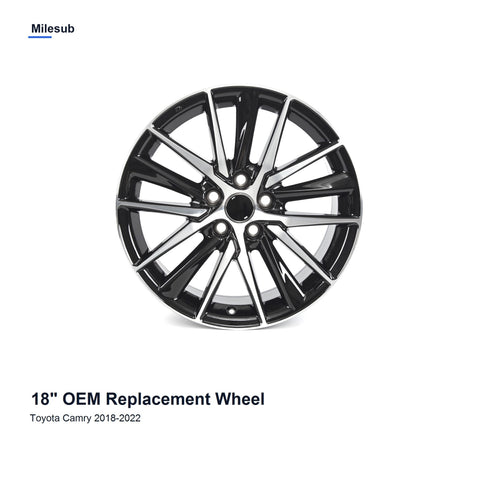 New 18"×8.0" OEM-Style Replacement Wheel for Toyota Camry 2018-2022 Machined Black
$179.99
View Wheel →
 New 19"×8.0" OEM-Style Replacement Wheel for Nissan Altima 2019-2022 Machined Black
$199.99
View Wheel →
 New 18"×8.0" OEM-Style Replacement Wheel for Honda Civic 2022-2025 Black
$170.00
View Wheel →
Ready to Find the Right Wheel?
Tell us your year, make, and model, and we will show you wheels built for your vehicle.