
The honest answer is that impact damage exists on a spectrum. Some hits leave a wheel cosmetically scuffed and structurally fine. Others bend a rim enough to affect sealing, balance, or safety. You cannot tell which one you have by looking at a photo — and you should not assume the worst before checking.
This guide walks through what pothole damage actually looks like, what you can inspect on your own, and what should send the car to a professional rather than back onto the highway.
What Pothole Damage Actually Looks Like
Pothole impacts concentrate a lot of force into a very small contact area — usually the outer edge of the rim, where the tire bead seats. What drivers typically notice afterward:
- A new vibration at certain speeds that wasn't there before
- A tire losing air slowly, sometimes only every few days — a rim that leaks air is covered separately
- The vehicle pulling to one side, or the steering wheel sitting slightly off-center
- Visible scraping or a flat spot on the rim's outer lip
- Nothing at all — which does not automatically mean nothing happened
That last one matters. A wheel can be out of round without showing an obvious dent, and a slow leak can stay slow for weeks.
What the Damage Might Be
Pothole damage generally falls into a few categories. These are possibilities to investigate, not a diagnosis:
| What may have happened | Typical signs |
|---|---|
| Cosmetic scuff only | Surface marks, no air loss, no vibration, tire holds pressure |
| Bent inner or outer rim lip | Slow air loss, visible wobble when spun, repeated leaks at the bead |
| Out-of-round wheel | Speed-sensitive vibration, often felt in the seat or steering wheel |
| Cracked rim (less common, more serious) | Rapid air loss, visible crack line, must not be driven on |
| Tire damage rather than wheel damage | Bulge in the sidewall, puncture, vibration from a broken belt |
Two important limits on what this table can tell you:
- Vibration is not proof of a bent wheel. Wheel damage can be one possible cause. Tire condition, balance, alignment, and suspension components can produce very similar symptoms. Only a physical inspection separates them. Why is my wheel or steering wheel vibrating? covers that symptom in full.
- Air loss is not proof of a bent wheel either. A leaking valve stem, a bead that didn't seat cleanly, or a puncture in the tire can all lose air while the wheel itself is fine.
What You Can Check Yourself
Here's a practical order, from safest to most involved.
Do this first — visual walk-around (engine off, parked level) 1. Look at the outer rim edge on the side that took the hit. Compare it to the opposite wheel — a difference in shape is more telling than an absolute judgment. 2. Look for a flat spot, a sharp crease, or cracking in the finish. Paint or clear-coat that has cracked in a line can indicate the metal underneath moved. 3. Check the tire sidewall for a bulge. A bulging sidewall means do not drive on it.
Next — tire pressure over time 1. Inflate to the vehicle's recommended pressure (on the driver's door jamb sticker, not the tire sidewall). 2. Re-check in 24 hours, then again at 3 days. A wheel that was fine before the hit and now drops pressure consistently points to the bead sealing area.
Next — what a shop can do that you shouldn't 1. Spin-balance check on the wheel while mounted, or a runout measurement off the car. 2. A proper leak-down test — submerging or spraying the bead, valve, and barrel to find where air is actually escaping. 3. Alignment check, because an impact hard enough to bend a wheel can also knock alignment out.
Do not attempt to straighten a rim yourself with heat or force. Aluminum alloy in particular can crack rather than bend back, and a rim that has been stressed once is not the same rim it was.
Repair It, or Replace It?
The decision path is inspect → diagnose → then repair or replace — not "replace everything that got hit." That decision has its own walkthrough in Bent Wheel: Repair or Replace?.
Repair may be considered when — and only as assessed by a qualified wheel repair professional after a physical inspection: - The damage is a minor bend in the outer lip, with no cracking anywhere on the wheel - The wheel holds air reliably after repair, verified over time rather than assumed - A qualified wheel repair facility confirms it is repairable after inspecting it with the tire removed - The wheel is a factory wheel you want to keep
Replacement is usually the practical answer when — as identified by that inspection, not by eye: - There is any crack in the rim - The bend affects the barrel or the mounting face, not just the cosmetic lip - The wheel won't hold air after a professional repair attempt - Repair cost approaches the cost of a correct replacement - You need the car back on the road reliably rather than perfectly
A note on being conservative here: a wheel is not a cosmetic part. It carries the tire, holds air, and takes every impact the suspension passes through. When a shop's inspection is genuinely borderline, replacing is the lower-risk call — and for most daily drivers, replacing one damaged wheel is far less disruptive than replacing a set.
Fitment Still Decides the Outcome
If the answer turns out to be "replace this wheel," fitment — not appearance — is what determines whether the replacement actually works.
The four specifications that have to be right:
- Diameter — must match the tire's inner diameter
- Width — affects tire seating and clearance
- Bolt pattern — the number of lugs and the circle they sit on; either it matches or it doesn't
- Offset — how far the mounting face sits from the wheel's centerline; wrong offset means rubbing, or a wheel that sits proud of the fender
Plus hub bore — the center hole that centers the wheel on the hub. A wheel that isn't hub-centric to the vehicle can produce a vibration that looks exactly like a bent wheel.
Your year, make, and model is the starting point for all of this — how to confirm wheel fitment is where that gets pinned down.
Before You Order a Replacement
A replacement wheel is only a good purchase if it's the right one. Before ordering:
- Confirm the specification match against your vehicle — not against "it looks the same." If you don't have the numbers yet, how to find your wheel size covers where to read them.
- Check what you're actually replacing — one damaged wheel, or a wheel whose finish you also want to match to the others.
- Confirm the finish and appearance you need, especially if you care about the other three wheels matching.
- Understand the condition and type of what you're buying — OEM-style replacement, reconditioned, or used, and what that means for you.
- Check the return path — what happens if it arrives and doesn't fit, or isn't what you expected.
- Ask about support — whether someone will actually help you confirm fitment before it ships.
How Milesub Approaches This
Milesub exists for exactly this moment: something happened to a wheel, and you want the car back to normal without turning it into a whole project.
The practical version of that:
- Replace what you need. A single damaged wheel doesn't have to become a full set replacement.
- Keep the factory look. The goal is a wheel that matches what's already on the car, not one that announces itself as different.
- Start from your vehicle. Fitment gets confirmed from year, make, and model — the same way the original wheel was specified.
From wheel problem to the right replacement, without guessing in between.
FAQ
Can I keep driving on a wheel I think is bent? It depends on what the inspection shows, and we won't guess for you. If the tire is losing pressure quickly, you can see a crack, or the sidewall is bulging, don't drive on it. For a slow leak or a mild vibration, have the wheel inspected by a qualified automotive professional promptly, and ask them directly whether the vehicle should be driven before that inspection — driving long-term on a compromised wheel risks the tire, not just the rim.
Does a bent wheel always mean I have to buy a new one? No. Minor bends without cracking are sometimes repairable by a qualified wheel repair shop. Cracks, damage to the barrel or mounting face, or a wheel that won't seal are typically replacement territory.
Will my insurance or the road authority cover it? Sometimes — pothole damage claims exist in many areas, and coverage depends entirely on your policy and local rules. Check with your insurer rather than assuming either way.
How do I know if the vibration is the wheel or something else? You generally can't without inspection. Tire condition, wheel balance, alignment, and suspension parts all produce similar symptoms. A shop can isolate it by measuring runout and checking balance directly.
If I replace just this one wheel, will it look wrong? It doesn't have to. Matching diameter, width, finish, and factory-style appearance is the whole point — which is why fitment comes before aesthetics, not after.
Should I replace all four because of one pothole hit? Almost never. Pothole damage is localized to the wheel that took the impact. Full-set replacement is driven by wear, a change in specification, or multiple damaged wheels — not by one bad hit. How many wheels you should actually replace goes deeper on that.
One Wheel or More Than One?
Impact, leak and vibration problems usually start at one corner, so one wheel is often all that is needed. What decides it is whether the other wheels are damaged as well, and whether a single replacement can be matched to the three that stay on the car.
- One wheel — the damage is on one corner and the other three hold air, run true and are not bent.
- More than one — more than one wheel is damaged, or the remaining wheels cannot be matched for diameter, width, bolt pattern, offset and center bore.
How Many Wheels Should I Replace? 1, 2, or All Four covers the count decision in full. Can I Replace Just One Damaged Wheel? covers matching a single wheel to an otherwise healthy set.
Find the Right Replacement Wheel for Your Vehicle
Four steps take you from "something is wrong with my wheel" to a wheel that is listed for your actual vehicle.
- Check your vehicle. Use the year, make and model selector at the top of this page, or send the details through Fitment Check and we will review them before you order.
- Confirm the five specs. Diameter, width, bolt pattern, offset and center bore. How to Check Wheel Fitment shows where each one is measured.
- Read the size off the tire you have now. How to Find Your Wheel Size shows where the size is printed and how to read it.
- Open your make and choose the wheel listed for your model year.
- Toyota Wheels
- Honda Wheels
- Nissan Wheels
- Tesla Wheels
- Hyundai Wheels
- Kia Wheels
- Ford Wheels
- Chevrolet Wheels
- BMW Wheels
- Volkswagen Wheels
- Mercedes-Benz Wheels
- Lexus Wheels
Browse every replacement wheel if you would rather start from the full catalogue.
Replacement Wheels Listed for Your Vehicle
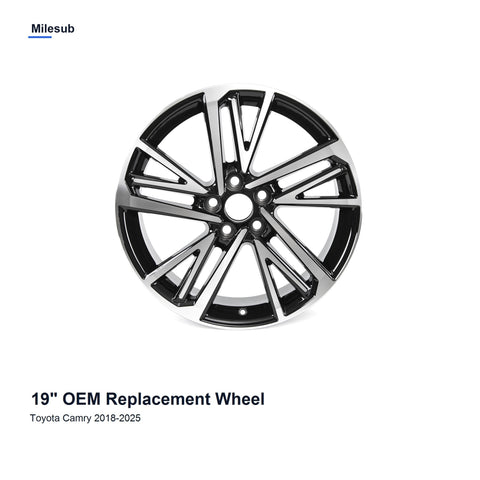
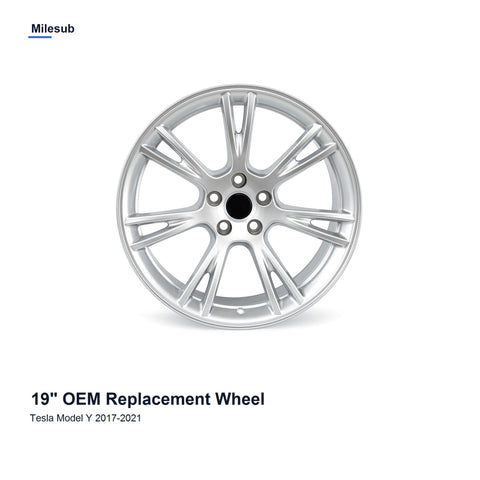
Each wheel below is listed by the year, make and model it was built for. Open one to see the exact vehicles it covers, then check it against your own specs before ordering.
Ready to Find the Right Wheel?
Tell us your year, make, and model, and we will show you wheels built for your vehicle.